

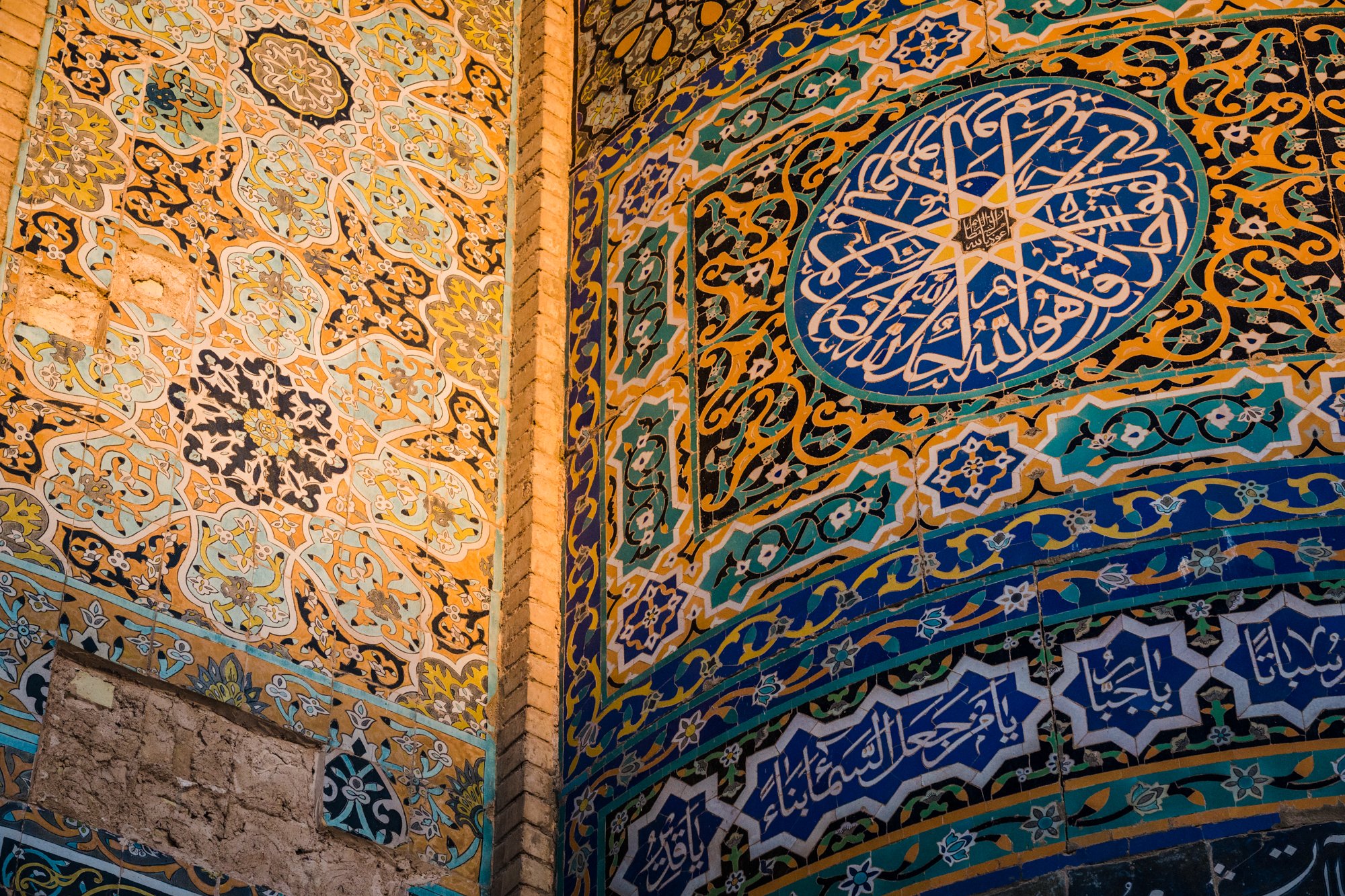
Journey #005: Afghanistan
The Road to Oxiana
A journey in the footsteps of Alexander
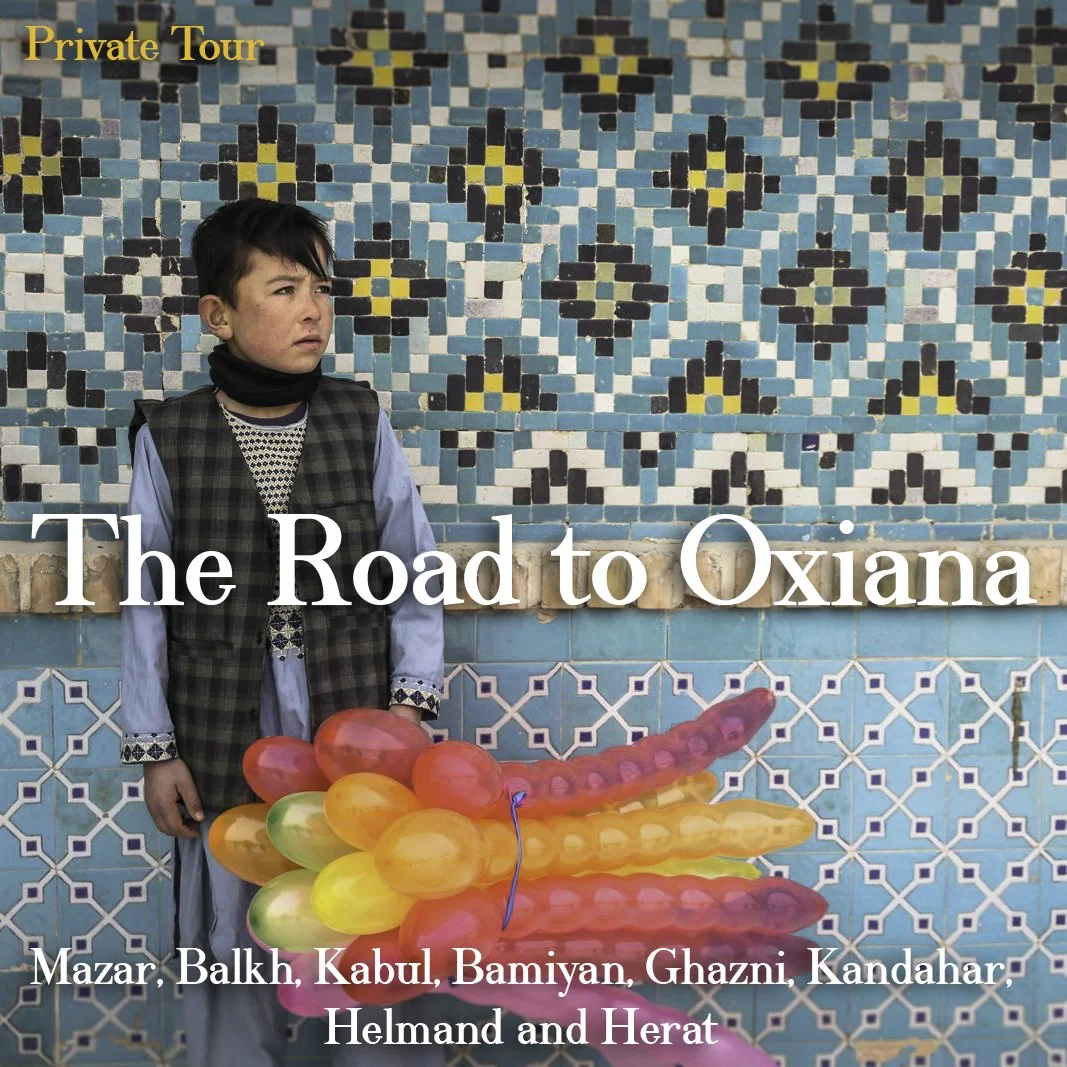
‘The Road to Oxiana’ is a 14-night journey through the ancient sites of Afghanistan in the footsteps of Alexander the Great.
We’ll be visiting some of the country’s most important historic sites including Balkh, otherwise known as Bactria and an off the track visit to the remains of Ai-Khanum
Our route will follow in the footsteps of famous explorers and travellers, including Marco Polo, Alexander the Great and the English traveller Robert Byron whose book first published in 1937 has inspired our trip.
As with any Safarāt journey, our route through the ancient often serves as a conduit to explore and understand the present. As usual we will be using our decades of collective experience in Afghanistan to curate special access for our travellers.
“The Road to Oxiana” will take us across the country’s Tajik and Uzbek ethnic heartlands, before crossing the soviet built Salang-Pass mountains to Bamyan, Kabul and onwards round the country’s “Highway 1” through Kandahar, Helmand finishing in Herat.
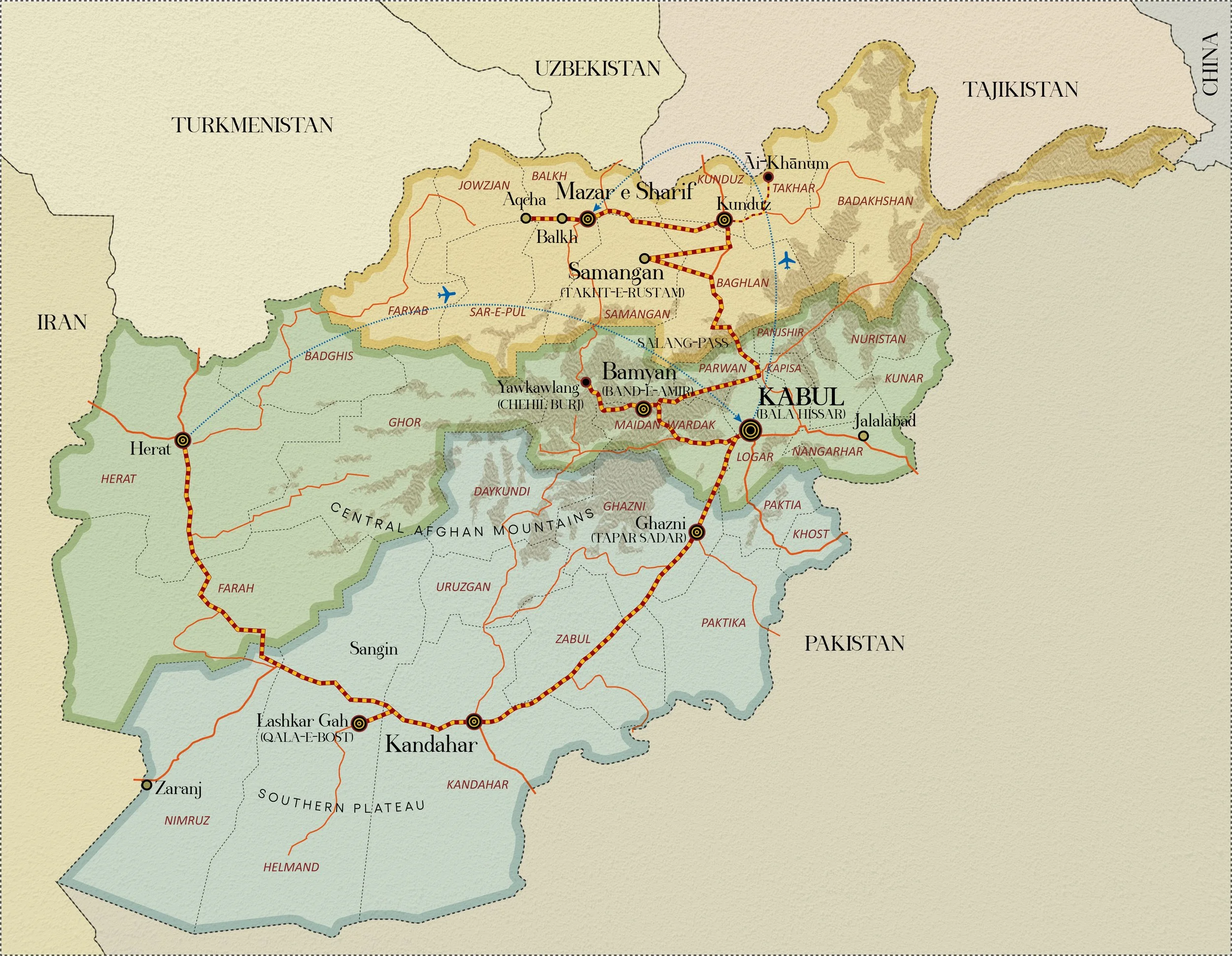
➤ Mazar E Sharif–Aqcha - Balkh – Herat – Herat –Minaret of Jam- Chaghcharan-Bamyan
➤ Mazar E Sharif–Aqcha - Balkh – Herat – Herat –Minaret of Jam- Chaghcharan-Bamyan

Itinerary
We understand that our travellers need to know where they will be visiting on our journeys, and broadly our tours stick to the routes published on our maps and on our website. What we don’t tend to do is publish our exact itineraries online for several reasons.
Firstly, and most importantly, this gives your guiding team the chance to make last minute changes to the itinerary based on seasonal opportunities or based on their decades of personal connections and relationships.
The focus of Safarat is on experiencing Afghanistan with Afghans, and that means spending as much time in the countryside and experiencing village life. While we guarantee you won’t miss out on the Buddha’s of Bamiyan or Qala-E-Bost if you are visiting Helmand, it does mean that we don’t visit the same places on every tour or use the same hotels and guesthouses on every trip.
This also gives the chance for our travellers to play a more active part in the trip, by becoming involved in the planning process. We recently had a traveller with an interest in an Achaemenid site on the Amu Daryu River and as a group were able to spend a day trying (…and succeeding) in finding the site.
We may choose to extend our stay in a town to take part in a festival or visit a village that we’ve been researching. All our itineraries are designed with one day of float built into them, to account for mechanical problems, broken bridges, or bad weather.
Day #001
You’ll be met by Noory on arrival at Kabul Airport. For much of the year, the flight into Kabul traces the snow-capped spine of the Hindu Kush, its peaks often still dusted white well into late summer. This striking mountain landscape sets the tone for the journey ahead and mirrors much of the terrain you will explore in northern Afghanistan.
After a short transfer to the domestic terminal, you’ll fly north-west to Mazar-e-Sharif, where you’ll be warmly welcomed by Ismail, our northern coordinator. A native Turkmen, Ismail has worked with Safarat since 2022. From the moment you arrive, the city feels distinct from Kabul, with a noticeably different rhythm and a richer ethnic mix, including strong Uzbek and Turkmen communities.
From the airport, we head into the old city of Mazar-e-Sharif for lunch near the Blue Mosque. Officially known as the Shrine of Ali, the mosque is believed by many to house the tomb of Ali ibn Abi Talib, cousin and son-in-law of the Prophet Muhammad, making it one of the most significant religious sites in Afghanistan. Much of the present structure dates to the Timurid period and is renowned for its luminous blue tilework, from which the city takes its name. You’ll have time to wander through the mosque complex at your own pace, and many travellers choose to sit quietly in the courtyard, taking in the scale and serenity of the surroundings.
The remainder of the evening is free to take care of practicalities such as exchanging currency, purchasing local SIM cards, and buying traditional clothing for the journey ahead.
Day #002
An early morning start takes us to the ancient city of Balkh, one of the oldest continually inhabited places in Central Asia. Known in antiquity as Bactra and later celebrated as “the Mother of Cities,” Balkh was once the capital of the region known to the Greeks as Oxiana and a key centre of learning, trade, and religion. It was conquered by Alexander the Great in the 4th century BCE, flourished under successive Persian, Buddhist, Islamic, and Timurid rulers, and for centuries rivalled cities like Samarkand and Bukhara in prestige. Today, its scattered ruins, city walls, and shrines hint at the immense importance it once held along the Silk Roads.
Our favourite site in Balkh is the Haji Piyada Mosque, one of the earliest surviving Islamic monuments in Afghanistan. Believed to date from the 9th century, during the early Abbasid period, the mosque is remarkable for its intricate carved stucco decoration and elegant Kufic inscriptions. Despite its ruined state, it offers a rare and evocative glimpse into the formative years of Islamic architecture in the region and is widely regarded as one of the most important early mosques in Central Asia.
Balkh has drawn travellers, scholars, and pilgrims for millennia. Chinese monk Xuanzang passed through in the 7th century and described a city rich with monasteries and learning. Later, Islamic geographers such as Al-Muqaddasi wrote of its wealth and sophistication, while the great poet and mystic Jalal al-Din Rumi was born here (we will be visiting what remains of his house!), cementing Balkh’s reputation as a spiritual as well as intellectual centre.
In the afternoon, we travel on to Aqcha, a predominantly Turkmen town renowned for its kelim weaving traditions. Aqcha is famous for producing some of the finest flat-woven carpets in the region, using local wool, natural dyes, and techniques passed down through generations. Ismail, who is himself involved in the carpet trade, will introduce you to some of the town’s best workshops and manufacturers. You’ll see the weaving process up close and, if you wish, have the opportunity to purchase kelims directly from the source at local prices—authentic, hand-made pieces rooted in centuries-old Afghan craftsmanship.
Day #003
A long day’s journey begins with a pre-dawn departure eastwards on the Kabul road from Mazar. We’ll pause in the soft morning light as Samangan stirs to life—smoke rising from the chimneys of kebab houses as the day begins. From here, we visit Takht-e-Rustam, one of Afghanistan’s most remarkable Buddhist sites. There are many places Safarat’s founder Joe claims as favourites, but Takht-e-Rustam—and in particular the striking Buddhist complex carved into the hillside beneath it stands above them all.
From Samangan, it’s time to prepare for the mountains. Snow chains are fitted as we enter the dramatic gorge at Tashkurgan before beginning the climb into the Hindu Kush. The crossing is defined by the Salang Tunnel, a landmark of Afghan infrastructure and a serious adventure in itself. Completed in 1964 with Soviet assistance, the tunnel was once the highest road tunnel in the world and revolutionised year-round travel between northern and southern Afghanistan. While road improvements have been promised for 2026, the route remains tough and demanding for now expect a long, gruelling day in the vehicle.
Once on the southern side of the Salang, the scenery opens into rolling mountain landscapes as we continue toward Bamiyan. It will have been a long day, but you’ll arrive after dark in a town that still feels very much like a village, calm and unhurried, and a welcome place to rest after one of the most dramatic drives of the journey.
Accommodation at ATO Guesthouse in Bamiyan
Day #004
We won’t ruin the surprise, but the view from your Bamyan hotel room is pretty special after your long journey the previous day. Bamyan may be a provincial capital, but it’s lost none of it’s village charm and you’ll feel like you’re wondering through the lanes of a village, through fields, past workers tilling the fields by hand towards the remains of the famous Buddhas of Bamyan . Most travellers enjoy spending a few hours wondering around the massive site - there is a huge amount to see beyond the two main buddhas, and once you are tired of exploring the frescos, caves and niches the charming bazaar is only a 10 minute walkaway. The Hazara people of Bamyan are the most welcoming and warm in Afghanistan, and you’ll find yourself welcomed into shops, encouraged to try seasonal fruits and asked to join chatting locals for tea.
The afternoon is for mountain lovers and those who enjoy the great outdoors. We’ travellers will have the choice of spending the day at the famous and instantly recognisable blue waters of Band-E-Amir national park. The site is Afghanistan’s number one destination for both international and domestic tourism, but despite this you’ll never feel crowded out and for many visitors it remains a reason they decided to visit the country in the first place.
Accommodation at ATO Guesthouse in Bamiyan
Day #005
Another morning in Bamiyan is spent exploring more of the valley’s remarkable archaeological sites, including the City of Screams and the Red City, also known as Zohak City. The City of Screams, or Shahr-e Gholghola, sits on a fortified hill overlooking the valley and is closely associated with the Mongol invasion of the 13th century. According to local tradition, the city was destroyed by Genghis Khan’s forces after a prolonged siege, its name echoing the cries said to have filled the valley during its fall. Today, its eroded walls and commanding views offer a stark reminder of Bamiyan’s role as a strategic and cultural crossroads on the Silk Road.
Nearby, the Red City of Zohak rises dramatically at the confluence of two rivers, its iron-rich cliffs giving the fortress its distinctive colour. Older than the City of Screams, Zohak dates back to pre-Islamic times and was later expanded and reused by successive dynasties who recognised its defensive importance. Together, these sites speak to Bamiyan’s layered history as a place of trade, religion, conquest, and resilience, long before the destruction of the Buddhas brought it global attention.
From Bamiyan we begin the journey south, through Wardak province and over several mountain passes above 2,500m before descending down to capital city Kabul.
Accommodation at 3* equivalent hotel in Kabul
Day #006
An early morning start for you as we hike across the Shir-Darwaza wall walk across the roof of Kabul. The hike is a great way to burn off the previous afternoon’s long car journey and takes about 4 hours. This is our favourite Kabul site – it is an ancient wall connecting two incredible monuments to defeated empires. We will start our hike at the Mughal Emperor Babur’s Garden.
Our route will then take us to the Bala Hissar Fort, scene of the pivotal events of both Anglo-Afghan wars. It’s also a good chance to have a chat with members of the Taliban who will accompany us on the walk and take some photos of them hiking up the wall.
After lunch we will visit the impressive Buddhist collection at Kabul Museum or one of the city’s surrounding Buddhist stupas. We’ll then move onto the old bazaar of Kabul to take a wonder round the city’s bird market.
Accommodation at 3* equivalent hotel in Kabul
Day #007
Today we will have a long day’s drive south through Wardak province on our way to the city of Ghazni. The city is one of Afghanistan’s most ethnically diverse, with a rich and bloody history to match.
Accommodation at 2* equivalent hotel in Ghazni or village homestay in Khwaja Umari
Day #008
An early morning start in Ghazni to visit the city’s incredible citadel, the famous minarets of Ghazni and the Buddhist site of Tepe Sadar. We will then begin our long drive across Zabul province to Kandahar, which will take us across the Pashtun ethnic belt.
Accommodation in 3* equivalent hotel in Kandahar
Day #009
We will spend the day in Kandahar which is Afghanistan’s de-facto new capital. There will be lots of time to waltz through the the old city’s bazaar, eating Shir-Yakh ice cream, visiting the home of the ‘father’ of the Afghan state Ahmed Shah Baba and end the evening climbing the famous 40 steps of the city as the sun sets.
Accommodation in 3* equivalent hotel in Kandahar
Day #010
After spending a couple hours visiting the site of “Old Kandahar” where Alexander the Great is said to have established the city, we will have the chance to explore the rich green Arghandab valley, which experienced some of Afghanistan’s most intense fighting against foreign forces.
The river basin is the birthplace of Mullah Omar and the spiritual heartland of the Taliban. We will be able to sit eating mantu dumplings in the orchards with our hosts, talk about the new Afghanistan and hear about the past from them. We will finish the day with the opportunity to swim in the cool waters of the Dahla dam before camping under the pomegranate trees of a village.
Accommodation in Arghanadab Homestay
Day #011
A short drive takes us from the city of Kandahar to Helmand province and onto Shamsher district, where we will find an enormous and ancient cave complex. The caves were first explored in 1956 by a French archaeological expedition who found remains of human habitation of the caves from the Kushan period. Several ancient relics were found by the expedition, including pottery from Samarra. Since then, few people have been able to visit the caves, and we will be some of the first foreign visitors at the complex for some years.
Accommodation at homestay or Lashkah Gah Hotel.
Day #012
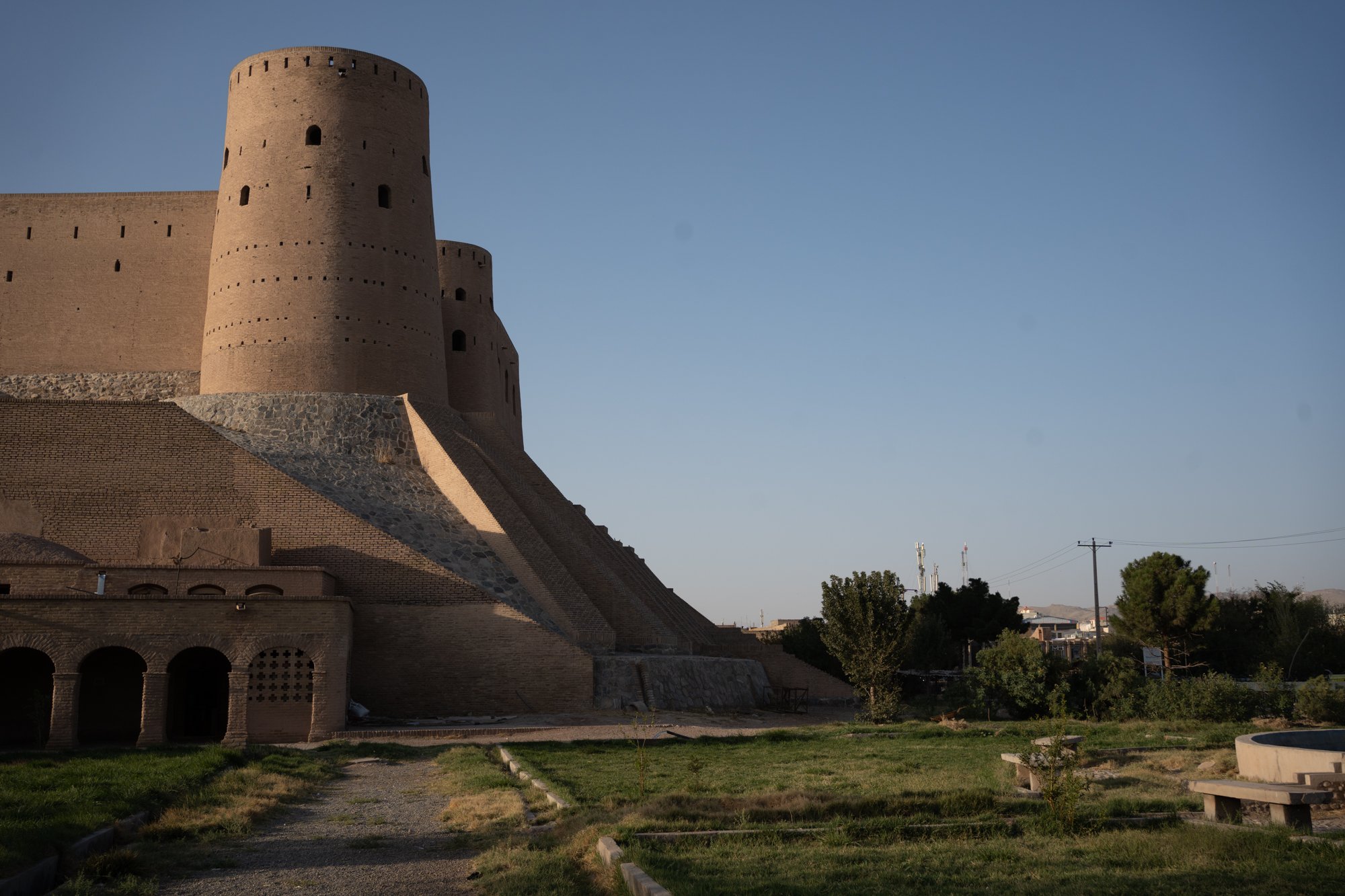
The day starts again at dawn as we walk from the ruins of Lashkar-e-Bazaar along the Helmand River all the way to Qala-E-Bost, famous for its 11th century decorative arch, which appears on the 100 Afghani note.
After lunch in the bazaar, we will be making the journey towards Sangin district and our homestay in Malmul Qala. This is for many of our guests the most special night of the trip, camped under the stars of the Helmand desert in the shadow of the village’s ancient castle joined by many of the elders of the community.
Accommodation in camping-homestay in Malmul Qala
Day #013
Today we head north through the harsh but beautiful deserts of Farah and Nimruz provinces towards Herat. We’ll be making a stop to be hosted for lunch by the Ahmadi family in their architecturally unique village, before arriving in the ancient, culturally rich city by nightfall.
Accommodation at Sadaf International Hotel in Herat
Day #014
We’ll spend the day sightseeing. Herat is my favourite city in Afghanistan, and we won’t need to get in the car at all today – it will all be walking supplemented by the use of a few tuktuks.
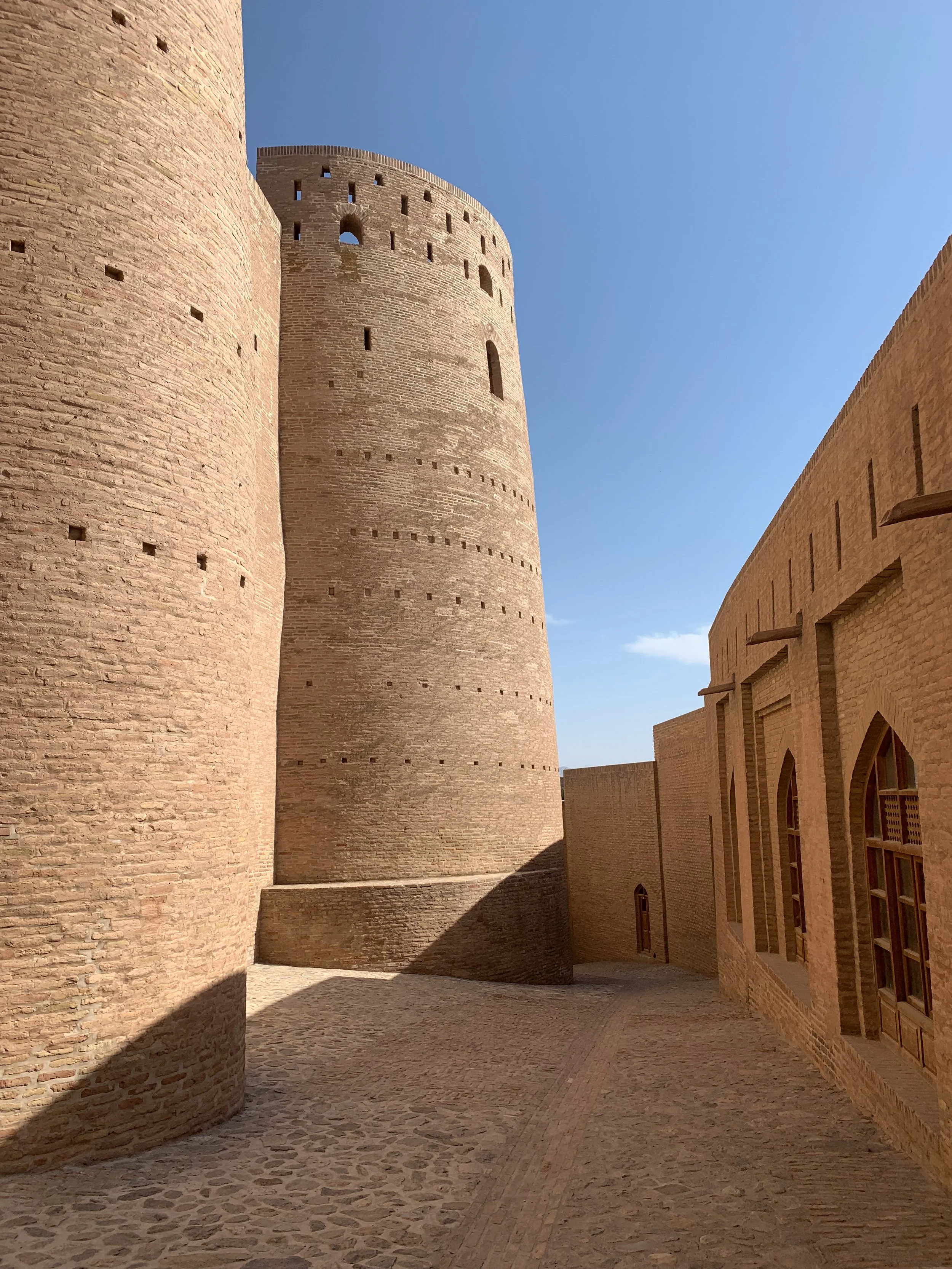
We’ll visit the city’s citadel, abandoned silk bazaar and of course the Great Mosque joined by our friend and city guide Shafi Mohammadi who will introduce us to the men who are restoring the ancient site in the tile factory.
Accommodation at Sadaf International Hotel in Herat
Day #015
This morning we will head to the airport to jump on a flight back to Kabul. We hope that your Safarāt journey will have contributed a small part to a return to these happier times in Afghan history.
Most flights to Dubai, Istanbul, Abu Dhabi, Delhi and Doha leave Kabul after lunchtime.
Book Now
‘The Road to Oxiana’ is a 14-night journey through the ancient sites of the fabled Kingdom of the Turqouise Mountain.
We’ll be visiting some of the country’s most important historic sites including Balkh, otherwise known as Bactria and an off the track visit to the
Our route will follow in the footsteps of famous explorers and travellers, including Marco Polo, Alexander the Great and the English traveller Robert Byron whose book first published in 1937 has inspired our trip.
As with any Safarāt journey, our route through the ancient often serves as a conduit to explore and understand the present. As usual we will be using our decades of collective experience in Afghanistan to curate special access for our travellers.
“The Road to Oxiana” will take us across the country’s Tajik and Uzbek ethnic heartlands, before following the Hari Rud river back through the central mountains to the old kingdom of the Hazrat Ali and its capital Bamyan.

Journey #005: The Road to Oxiana
A journey in the footsteps of Alexander
-
This trip starts in Mazar-E-Sharif officially in the afternoon/evening of the advertised start date.
An internal flight is included in the price of this trip to the start of the trip from Kabul.
This gives our travellers the chance to fly into Kabul and transit onto their chosen internal flight.
At present there are no direct international flights to or from Mazar-E-Sharif or Herat, although this sometimes changes with the vagary of everything in Afghanistan.
Whilst we appreciate that relying on internal flights is not ideal, it is by far the most comfortable way of travelling and avoids a drive which can sometimes take 12-hours or more.
If you don't want to fly internally we can arrange private transport in a local car to Mazar-E-Sharif for an additional $70 USD - you will have to travel the day before the start of your trip and be ready to leave Kabul early on the morning of the 27th.
As an example and to give you an idea on when you need to arrive in Kabul on an international flight, on our September 2024 trip your group will be flying on:
Ariana Airlines, FG-261 leaving Kabul Domestic Terminal @ 1330 and arriving at Mazar-E-Sharif @ 1420
There will always be a member of Safarāt staff at Kabul airport on your advertised start date to help you at the airport to greet you and help you move to the domestic terminal with is a very short walk away or keep you company whilst you wait. Your trip guides may already be in Mazar-E-Sharif with our vehicles
If for some reason you miss your internal flight or are delayed in arriving in the country, then we will rebook you on a flight the following day.
If you choose to arrive in Kabul the day before the start of your trip, and need airport transfers and a hotel for the evening then this this is payable in cash locally at a cost of $160USD.
This cost will also cover having a local guide with you if you want to spend the day walking round Kabul, shopping or doing any additional sight seeing.
-
The trip officially ends on the last day of the advertised trip which means that you should plan to fly back to Kabul and out of the country on this last day.
For out Autumn 2024 trip this means booking a flight on the 12th of October
Most of our guests will probably choose to fly on Kamair RQ-102 which leaves Herat at 11:45 and arrives in Kabul at 1300.
Our experience is that Kamair flights often run an hour or two behind schedule, so we would recommend booking an onward flight from Kabul at 1800 or 1900.
This internal flight is not included as part of the trip cost.
If you want to spend an additional day in Kabul at the end of the trip and need transfers and a hotel then this is payable at a cost of $160USD locally in cash. This cost includes the cost of one of our local guides taking you round the city, doing any shopping or taking you to any additional sightseeing sites.
We cannot easily facilitate you spending extra days in Herat
-
There are daily flights between Kabul and Tashkent, Islamabad, Doha, Jeddah, Riyadh/Jeddah, Abu Dhabi, Dubai, Istanbul and Ankara via five airlines - Turkish Airlines, Air Arabia, Ariana, Kamair and Fly Dubai
We prefer flying with Kam Air or Fly Dubai who have a more modern fleet of planes, and are more reliable and punctual than Ariana.
If you are struggling to pay for your flights via Kamair’s website, we recommend that you use their app which seems to work better with foreign credit cards.
To book a flight on Ariana please use their website. Their flights do not show up on google flights .
-
It’s a legal requirement that all of our guests travel with at least basic medical and insurance and we appreciate that finding a suitable insurance policy can be difficult.
You should be very careful if you have an annual worldwide travel policy in place, to make sure that you are covered for travel to Afghanistan as it is excluded by most general travel insurers.
The cost of insurance varies hugely based on where you’re resident, where you’re from and the time of year along with a number of other variables.
As an example, residents of the UK are able to get suitable cover from High Risk Voyager for around $100USD for a 4 day trip to Afghanistan and we have a good and personal relationship with the company. That means they understand our business, who we are and what we do, and vice versa.
Many of our travelers have bought insurance successfully from IATI, although reviews online are far more mixed.
Travellers on our trips are required to have a minimum of $300,000 USD cover for medical emergencies and an additional $300,000 USD cover for emergency evacuation.
You must have Afghanistan specifically named as a location you are covered for on your insurance. Normal travel insurance does not typically cover traveling in Afghanistan.
For more information about out insurance requirements, please have a look at out our latest terms and conditions.
-
A suggested kit list will be sent to you when you book onto your chosen itinerary in the new Safarāt traveller hand guide.
No specialist equipment is required for this trip, but you’ll be passing through passes of over 2000m in the mountains of Bamiyan and many of our travellers have been surprised how cold the province can be even in the summer. Sturdy footwear is a must and some travellers prefer to bring trekking poles to explore the unmade and steep paths we’ll be walking through.
Both men and women are required to dress conservatively in Afghanistan. That means both men and women will need to wear long sleeve shirts and trousers.
Women will need to wear a headscarf from the point of arrival in Kabul airport and from September 2024 we will be asking all female travellers to wear a Black abaya. You can read more about travelling as a woman with us in Afghanistan here.
You will need to bring between $300-500USD for spending money, lunches, water, drinks etc. Please only crisp and fresh $100 bills to exchange for local currency in Afghanistan.
Smaller denominations, old issues or damaged notes will attract a poorer exchange rate. It is possible to exchange Euros in some places – the minimum denomination is 50, but dollars are highly preferred. There are a few ATMs in Kabul, but they are often out of order and Afghanistan is still a country where cash is king.
We strongly strongly recommend carrying a mastercard/visa credit card with you in case of a medical emergency that needs funding before your medical insurance kicks in.
There are lots of opportunities to buy nice crafts, souvenirs, carpets and textiles so leave some space in your bags.
Simcards are available to hire from Noory directly for $30 USD for the trip with unlimited data.
Please do not bring a drone with you to Kabul - it will be confiscated upon arrival and it will create a huge headache for us.
-
This is one of the most common questions we get asked from our potential travellers. There are two answers.
The Short Answer: Yes there will be times where you can get away from the tour.
The Long Answer: .There is no specific threat to foreigners in Kabul, but miscommunication and misunderstandings are common and although more and more international tourists are visiting Afghanistan you will still stick out like a sore thumb. Getting round the city is complicated and trying to use publics transport is fairly baffling.
In Bamiyan the situation is a little bit different and there is probably more opportunity to get yourself lunch alone in the bazaar and have a chat with local people. Noory understands foreign tourists well
Generally speaking we try and pack as much into our tours as possible, which makes it difficult for lots of people to do lots of different things.
We always try to accommodate all our travelers though and understand if you need an afternoon off from the tour.
-
The situation with Afghan Consulates around the world is currently confused due to the change in regime in Kabul in August 2021. Whilst some Afghan embassies (Doha for example) are directly controlled by the new Taliban government in Kabul, most other Afghan embassies in European capitals are still controlled by the remnants of the old internationally recognised government.
This makes for a confusing and sometimes varying set of rules to get a tourist visa for the country, with each embassy having their own set of procedures. Some embassies have stopped issuing tourist visas all together (Geneva is one of these places), some embassies are still pretending to communicate with the Ministry of Foreign affairs and some are issuing visas to anyone with enough cash
The best places for our tourists to get a visa at the moment are Peshawar in Pakistan and Abu Dhabi both of which offer visas quickly on a same day basis.
As part of every Safarāt trip we now run a free shuttle from the Torkham border with Pakistan to Kabul for the start of the trip. This enables you to get your visa in Peshawar in the morning and arrive in Kabul the same day. An additional nights accommodation is payable directly to the guesthouse.
For more up-to date information on the ever changing Afghan visa situation please check this page.
Please contact us directly if you have any questions about visas at hello@safarat.co
For travellers starting their journeys from the UAE we have a relationship with a visa agent in Abu Dhabi who can collect and process your visa application for approximately $130USD within 24-hours.
-
Please find our full terms and conditions here.
What’s Included:
- All accommodation: based on 2 guests sharing a room
- Breakfast and Dinner - or your main meal of the day.
- Private Transport: in your own air conditioned 2 wheel drive car
- Guiding by Joe Sheffer and Noory Qudratullah
-Local Travel Permits
- Visa support and invitation - we will provide more details about how to get your visa and provide an invitation where required from our registered Kabul company.
-Admission Fees to sites.
What’s Not:
- Lunch - often a casual/light affair particularly when we are driving and travelling.
- Visa Fees payable directly to embassy
-Flights to and From Afghanistan or to/from Mazar-E-Sharif and Herat
-Local Flights in Afghanistan in event of an emergency or change of schedule due to security or bad weather or road conditions.
-Laundry in hotels
-Tips to Drivers, Porters and Local Guides